Best AI Toys for Kids: What’s Real, What’s Hype
AI toys for kids should demonstrate genuine adaptive learning, voice interaction, or basic generative capabilities, not just marketing buzz. Prioritize age-appropriate content, robust privacy policies, and clear safety features.
What Are AI Toys for Kids and Do They Really Use Artificial Intelligence?
When you hear the term “AI toys for kids,” it’s easy to imagine futuristic robots and highly sophisticated gadgets. However, the reality is that the term “AI” is often used broadly in the toy industry, sometimes stretching to include technologies that are not truly artificial intelligence. Understanding what qualifies as AI and what doesn’t can help you make informed decisions when choosing toys for your child.
Defining AI in the Context of Toys
Artificial Intelligence, in its simplest form, refers to machines or systems that can perform tasks that would typically require human intelligence. In the world of kids’ toys, AI can manifest in several ways:
- Voice Recognition and Response: Toys that can understand and respond to voice commands, like interactive voice assistants.
- Adaptive Learning: Systems that adjust the difficulty or type of content based on the child’s interactions and performance.
- Generative Chat: Toys that can generate responses in a conversation, often using pre-programmed scripts but giving the illusion of understanding.
- Pattern Recognition: Toys that can recognize patterns, such as shapes, colors, or even facial expressions.
Many toys marketed as “AI” use a combination of these features, but it’s important to note that not all of them employ advanced AI. For example, voice-activated toys often rely on pre-programmed responses rather than true machine learning. While they may seem intelligent, they are often limited to specific commands and lack the ability to learn or adapt beyond their initial programming.
Marketing vs. Reality
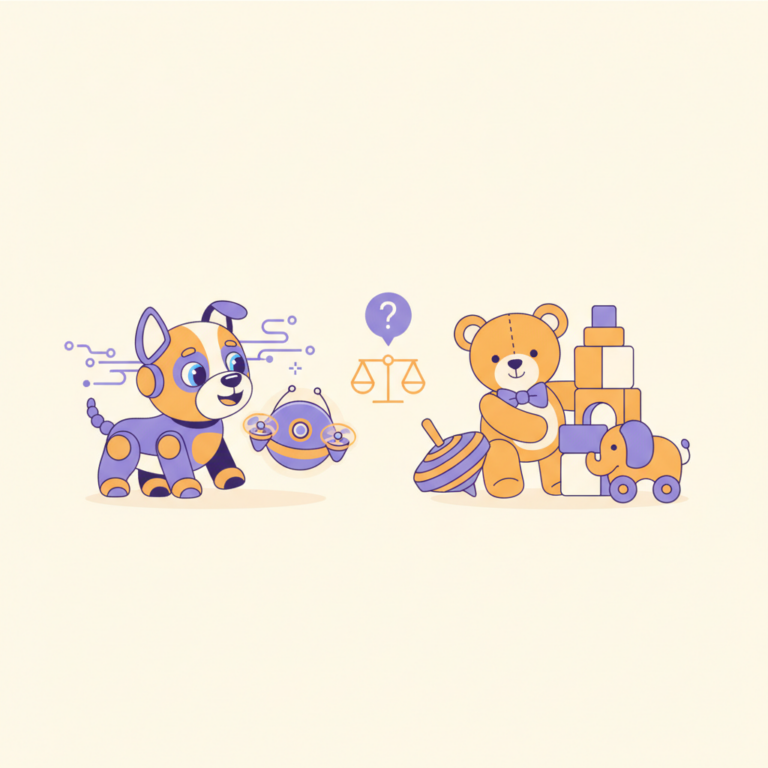
The toy industry is not immune to the allure of buzzwords, and “AI” is frequently used as a marketing tool. Some toys labeled as AI are simply automated with basic sensors and pre-programmed responses. For instance, a toy that changes its behavior based on light or sound might be marketed as “smart” or “AI-powered,” but it doesn’t truly utilize artificial intelligence.
To distinguish between marketing hype and genuine AI, look for toys that explicitly mention features like machine learning, natural language processing, or adaptive algorithms. These are indicators that the toy may indeed incorporate more sophisticated AI technologies.
Privacy and Data Concerns
One critical aspect to consider when choosing AI toys is privacy and data security. Many AI toys, especially those with voice recognition and internet connectivity, collect and transmit data. This data can include voice recordings, conversation logs, and even personal information about your child.
Here are some key privacy considerations:
- Data Collection: Understand what data the toy collects and how it is used. Look for toys that have clear privacy policies and data handling practices.
- Data Storage: Find out where the data is stored and how it is protected. Some toys store data locally, while others send it to cloud servers.
- Parental Controls: Choose toys that offer robust parental controls, allowing you to manage data collection and monitor interactions.
- Security Measures: Ensure the toy has adequate security measures in place, such as encryption and secure authentication, to protect against unauthorized access.
It’s also wise to stay informed about any reported security breaches or issues with the toy you are considering. Reputable manufacturers will often address these concerns promptly and transparently.
In the next section, we will explore why you should consider AI toys for your child’s development, weighing the benefits against the potential downsides.
Why Should You Consider AI Toys for Your Child’s Development?
AI toys offer a range of potential benefits that can contribute to your child’s development. However, it’s important to balance these benefits with the possible downsides, such as privacy concerns and the risk of over-reliance on technology.
Benefits of AI Toys
AI toys can provide several advantages for children:
- Engagement and Interactivity: AI toys often respond to children’s actions, making playtime more engaging and interactive. This can help keep children interested and motivated to learn.
- Personalized Learning: Some AI toys adapt to the child’s skill level, providing a personalized learning experience that can be more effective than a one-size-fits-all approach.
- Skill Development: AI toys can help develop various skills, including problem-solving, critical thinking, and language skills. For example, toys that use voice recognition can enhance language development by encouraging verbal interaction.
- Social Interaction: Certain AI toys are designed to facilitate social interaction, either between the child and the toy or among children playing together.
Potential Downsides
Despite their benefits, AI toys also have potential downsides:
- Privacy Risks: As mentioned earlier, AI toys can collect and transmit data, which can pose privacy risks if not properly managed.
- Over-reliance on Technology: There is a risk that children may become overly dependent on AI toys, potentially impacting their ability to engage in imaginative, unstructured play.
- Limited Creativity: Some AI toys may restrict creativity by providing predefined responses and interactions, leaving little room for the child to explore and create their own narratives.
When considering AI toys, it’s essential to weigh these factors and choose toys that align with your child’s needs and your family’s values.
Age Appropriateness
AI toys, like all children’s products, should be age-appropriate. Manufacturers typically provide age recommendations, but it’s important to consider your child’s individual maturity and developmental stage. For example, a toy with complex language interactions may be suitable for an older child but overwhelming for a younger one.
In the next section, we will delve into the different types of AI toys available, from voice assistants to adaptive learning systems, and discuss the criteria for choosing the right one for your child.
Types of AI Toys: From Voice Assistants to Adaptive Learning Systems
AI toys come in various forms, each offering unique features and benefits. Understanding the different types can help you choose the right toy for your child. Below is a detailed comparison of the main categories of AI toys:
| Type | Best for | Pros | Watch-outs |
|---|---|---|---|
| Voice Assistants | Children who enjoy interactive conversations and learning through dialogue. | Encourages language development, provides instant answers, can be educational. | Privacy concerns, potential for inappropriate content, limited understanding of context. |
| Adaptive Learning Systems | Children who benefit from personalized learning experiences. | Adjusts difficulty based on performance, provides targeted feedback, supports skill development. | May be less engaging for some children, can be expensive, requires consistent use to be effective. |
| Generative Chatbots | Children who enjoy imaginative play and storytelling. | Fosters creativity, encourages conversation, can be entertaining. | Limited understanding of complex queries, may produce nonsensical responses, potential for inappropriate content. |
| Robotic Toys | Children who are interested in technology and engineering. | Can be costly, may require assembly, some models have small parts that pose choking hazards. | |
| Smart Construction Sets | Children who enjoy building and creating. | Some sets are complex and may require adult assistance, can be expensive. |
Voice Assistants
Voice assistants, such as Amazon Alexa and Google Assistant, are increasingly being integrated into toys. These toys can respond to voice commands, answer questions, and even tell stories. They can be a great way for children to learn and explore, but they also come with privacy concerns. It’s crucial to review the privacy settings and data handling practices of the voice assistant before introducing it to your child.
Adaptive Learning Systems
Adaptive learning systems use algorithms to adjust the difficulty and type of content based on the child’s performance. This can provide a personalized learning experience that helps children progress at their own pace. However, these systems can be less engaging for some children and may require consistent use to be effective.
Generative Chatbots
Generative chatbots are designed to simulate conversation. They can be a fun way for children to engage in imaginative play and storytelling. However, they may produce nonsensical responses and have limited understanding of complex queries. It’s important to supervise interactions with these toys to ensure the content is appropriate.
Robotic Toys
Robotic toys, such as those from WowWee and other manufacturers, combine AI with physical play. These toys can move, respond to stimuli, and even learn from interactions. They can be highly engaging and promote problem-solving and spatial awareness. However, they can be costly and may require assembly. Some models have small parts that pose choking hazards, so it’s important to check age recommendations.
Smart Construction Sets
Smart construction sets, such as LEGO Mindstorms, combine traditional building with AI elements. These sets can enhance creativity and develop fine motor skills. They can also be educational, teaching children about engineering and programming. However, some sets are complex and may require adult assistance, and they can be expensive.
In conclusion, AI toys offer a range of features and benefits, but it’s important to consider the type of AI, the child’s age and interests, and the potential privacy and safety implications. By understanding these factors, you can choose AI toys that provide a safe and enriching play experience for your child.
How to Choose the Right AI Toy: Key Criteria to Consider
Selecting the right AI toy for your child can be a daunting task, given the wide variety of options available. To make an informed decision, consider the following key criteria:
1. Educational Value
One of the primary reasons to invest in AI toys is their potential to provide educational benefits. When evaluating a toy, consider the specific skills it aims to develop. For instance, some AI toys focus on teaching coding and programming, while others might focus on language skills, math, or even emotional intelligence. Look for toys that align with your child’s interests and learning needs. It’s also important to assess whether the toy offers a balanced mix of entertainment and education, as this will keep your child engaged while they learn.
2. Age Appropriateness
AI toys, like any other toys, come with age recommendations. These guidelines are not just about the complexity of the toy but also about ensuring safety and suitability for your child’s developmental stage. For example, a toy designed for a 5-year-old might focus on basic problem-solving and motor skills, while a toy for a 10-year-old might delve into more complex subjects like coding or robotics. Always check the recommended age range and consider your child’s individual abilities and interests.
3. Interactivity and Engagement
The level of interactivity a toy offers is crucial. AI toys that respond to a child’s actions, voice, or touch can provide a more engaging experience. Look for toys that offer a variety of interactive features, such as voice recognition, touch sensors, or motion detection. The more interactive the toy, the more likely it is to hold your child’s attention and encourage active participation. Additionally, consider whether the toy offers adaptive learning, where it adjusts its difficulty level based on your child’s performance, providing a personalized learning experience.
4. Durability and Build Quality
AI toys can be quite sophisticated, and their durability is an important factor to consider. Check the materials used in the toy’s construction and read reviews to gauge its durability. A well-built toy will withstand the rigors of play and last longer, providing better value for money. Additionally, consider whether the toy is easy to clean and maintain, as this will ensure it remains in good condition over time.
5. Safety Considerations
Safety is paramount when choosing any toy for your child. AI toys often contain small parts, batteries, or electronic components that can pose risks if not properly designed. Always check for safety certifications and look for toys that have been tested for hazards such as choking, electrical safety, and chemical exposure. Pay attention to age recommendations and warnings about small parts or batteries, especially for younger children.
6. Cost and Value
AI toys can vary widely in price, and it’s important to consider the value they offer. While some high-end toys come with a hefty price tag, they may offer advanced features and longer-lasting engagement. On the other hand, more affordable options can still provide significant educational and entertainment value. Consider your budget and weigh the features and benefits of each toy to determine if it offers good value for money.
Age-Appropriate AI Toys: Finding the Perfect Match for Your Child
Choosing an AI toy that is age-appropriate is crucial for ensuring your child gets the most out of the experience. Here’s a breakdown of what to look for based on different age groups:
1. Toddlers (Ages 2-4)
For toddlers, AI toys should focus on basic skills such as color and shape recognition, motor skills, and simple problem-solving. Look for toys that are easy to handle and have large, colorful buttons or touch-sensitive surfaces. Examples include interactive stuffed animals that respond to touch or voice, or simple robots that can be programmed with basic commands. Safety is particularly important at this age, so ensure the toy has no small parts and is made from non-toxic materials.
2. Preschoolers (Ages 4-6)
Preschoolers are ready for more interactive and engaging AI toys that can help develop language, math, and problem-solving skills. Toys that incorporate storytelling, music, and simple games are ideal. Look for toys that respond to voice commands or allow children to create simple programs. For example, a robot that can be programmed to follow basic instructions or a voice assistant that can tell stories and answer simple questions.
3. Early Elementary (Ages 6-8)
At this age, children can handle more complex AI toys that focus on coding, robotics, and more advanced problem-solving. Look for toys that offer a variety of interactive features and allow for creative exploration. Examples include programmable robots that can be controlled via a tablet or smartphone, or AI-powered building blocks that teach coding concepts through hands-on play.
4. Late Elementary (Ages 8-10)
Older children can handle even more sophisticated AI toys that delve into complex subjects like robotics, engineering, and computer science. Look for toys that offer advanced programming options and allow for creative problem-solving. Examples include AI-powered kits that teach engineering and coding through the construction of robots or other devices, or interactive science kits that use AI to explain scientific concepts.
5. Preteens and Teens (Ages 10+)
For preteens and teens, AI toys can offer a deeper dive into complex subjects like artificial intelligence, robotics, and programming. Look for toys that offer advanced features and allow for extensive customization and creative exploration. Examples include AI-powered drones that can be programmed for specific tasks, or robotics kits that teach engineering and coding through the construction of sophisticated machines.
The Role of AI Toys in Pets: Are There Smart Toys for Your Furry Friends?
While AI toys are often associated with children, they also have a place in the world of pet care. Smart pet toys can provide entertainment, stimulation, and even health benefits for your furry friends. Here’s what you need to know about AI toys for pets:
1. Interactive Play
AI-powered pet toys can offer interactive play experiences that mimic the unpredictability of real-life play. For example, some toys can move in random patterns, change direction, or respond to your pet’s movements. This can provide hours of entertainment and stimulation, especially for pets that are left alone for long periods.
2. Health Monitoring
Some AI pet toys come with sensors that can monitor your pet’s activity levels, sleep patterns, and even health indicators like heart rate. This data can be accessed via a smartphone app, allowing you to keep track of your pet’s well-being and make informed decisions about their care.
3. Training and Behavior Modification
AI toys can also be used to aid in training and behavior modification. For example, some toys can dispense treats based on your pet’s behavior, providing positive reinforcement for good behavior. This can be particularly useful for training puppies or modifying unwanted behaviors like excessive barking or chewing.
4. Safety Considerations
When choosing an AI pet toy, it’s important to consider safety. Look for toys that are made from non-toxic materials and have no small parts that could be swallowed. Additionally, ensure that the toy is durable enough to withstand your pet’s play style and that it doesn’t have any sharp edges or points that could cause injury.
5. Cost and Value
AI pet toys can vary widely in price, so it’s important to consider the value they offer. While some high-end toys come with advanced features and extensive capabilities, more affordable options can still provide significant benefits. Consider your budget and weigh the features and benefits of each toy to determine if it offers good value for money.
In conclusion, AI toys for pets can offer a range of benefits, from entertainment and stimulation to health monitoring and training. When choosing a smart pet toy, consider your pet’s needs, safety, and your budget to find the perfect match.
Privacy and Data Security: Understanding the Trade-offs of AI Toys
When considering AI toys for your child, it’s crucial to understand the implications for privacy and data security. These toys often come with advanced features that rely on data collection and internet connectivity, which can raise concerns for many parents.
Data Collection and Storage: AI toys typically collect data to improve functionality and user experience. This can include voice recordings, interaction patterns, and even personal information. It’s important to research how this data is stored and used. Some toys store data locally, while others upload it to cloud servers. If data is stored in the cloud, find out where the servers are located and what security measures are in place.
Third-Party Sharing: Another critical aspect is whether the toy manufacturer shares data with third parties. Some companies may use the data for targeted advertising or to improve other products. Always check the privacy policy to understand how your child’s data is handled. Look for toys that offer robust privacy settings and allow you to control data sharing.
Parental Controls: Many AI toys come with parental control features that let you manage data collection and sharing. These can include options to delete stored data, set up password protection, and limit internet connectivity. Take advantage of these features to enhance your child’s privacy and security.
Regulatory Compliance: Ensure that the toy complies with relevant data protection regulations, such as the Children’s Online Privacy Protection Act (COPPA) in the United States. Compliance with such regulations is a good indicator that the manufacturer takes privacy seriously.
Transparency: A trustworthy AI toy will have clear and accessible information about its data practices. If a company is vague or evasive about how they handle data, it may be best to look for an alternative.
Balancing the benefits of AI toys with privacy concerns is a challenge, but being informed and proactive can help you make the best decision for your family.
Caring for and Troubleshooting AI Toys: Tips for Longevity and Performance
To ensure your child’s AI toy remains in good working condition and continues to provide educational value, proper care and troubleshooting are essential.
Regular Maintenance: Just like any electronic device, AI toys require regular maintenance. This includes keeping the toy clean and dust-free, especially around speakers and microphones. Use a soft, dry cloth to wipe the surface and avoid using harsh chemicals that could damage the toy’s exterior.
Software Updates: Many AI toys receive software updates that improve functionality and security. Check the manufacturer’s website or app regularly for updates and follow the instructions to install them. This will ensure your toy has the latest features and protections.
Battery Care: If your AI toy is battery-operated, follow the manufacturer’s guidelines for battery replacement. Use the recommended type and size of batteries, and avoid mixing old and new batteries. For rechargeable toys, ensure the battery is charged according to the instructions to prolong its life.
Troubleshooting Common Issues: If your AI toy isn’t functioning properly, try these troubleshooting tips:
- Check the Power: Ensure the toy is turned on and has enough battery power.
- Internet Connection: Verify that the toy is connected to the internet if required.
- Restart the Toy: Sometimes, simply turning the toy off and on again can resolve issues.
- Update Software: Make sure the toy has the latest software updates.
- Consult the Manual: Refer to the user manual for specific troubleshooting guidance.
If these steps don’t resolve the issue, contact the manufacturer’s customer support for further assistance.
AI Toy FAQs: Common Questions and Honest Answers for Parents
As AI toys become more popular, parents often have questions about their use and impact. Here are some common FAQs and honest answers to help you make informed decisions.
1. Are AI toys safe for my child?
AI toys are generally safe, but it’s important to follow age recommendations and supervise younger children during play. Look for toys that comply with safety standards and have robust privacy measures.
2. How do AI toys benefit my child’s development?
AI toys can enhance cognitive, social, and emotional development by providing interactive and adaptive learning experiences. They can help with problem-solving, language skills, and creativity.
3. Can AI toys replace human interaction?
While AI toys offer valuable learning opportunities, they should not replace human interaction. It’s important for children to engage in face-to-face play and conversation with family and peers.
4. What data do AI toys collect?
AI toys may collect data such as voice recordings, interaction patterns, and personal information. Always review the privacy policy to understand what data is collected and how it’s used.
5. How can I protect my child’s privacy with AI toys?
Use parental controls to manage data collection and sharing, and choose toys with strong privacy settings. Regularly check for software updates and review stored data to ensure your child’s privacy is protected.
Choosing the Right AI Toy: Key Takeaways and Practical Guidance
When selecting an AI toy for your child, consider the following key factors:
| Factor | Considerations |
|---|---|
| Age Appropriateness | Ensure the toy is suitable for your child’s age and developmental stage. |
| Privacy and Security | Research data collection and sharing practices, and use parental controls. |
| Educational Value | Look for toys that offer meaningful learning experiences and promote skill development. |
| Durability and Maintenance | Choose toys that are well-built and easy to maintain, with accessible customer support. |
| Interactivity and Engagement | Select toys that encourage interaction and hold your child’s interest over time. |
By considering these factors, you can choose an AI toy that provides a safe, engaging, and educational experience for your child. Remember, the best AI toy is one that complements your child’s interests and supports their overall development.
Key takeaways
- Genuine AI features include voice recognition, adaptive learning, and basic chatbots.
- Age-appropriate content and complexity are crucial for engagement and safety.
- Privacy policies should be transparent, with data collection minimized.
- Safety features like parental controls and durable construction are important.
- Many 'AI' toys are basic, with limited interactive capabilities.
Frequently asked questions
What actually counts as AI in kids' toys?
Genuine AI features include voice recognition, adaptive learning that adjusts to the child's abilities, and basic generative chat capabilities.
How can I tell if an AI toy is age-appropriate?
Check the manufacturer's recommended age range and look for toys that offer content and complexity suitable for your child's developmental stage.
What privacy concerns should I be aware of?
Look for toys with clear, transparent privacy policies, minimal data collection, and strong security measures to protect your child's information.
Are there safety features I should look for?
Seek toys with parental controls, durable construction, and safety certifications to ensure they are safe for children to use.
How important are battery life and charging?
Consider toys with long battery life or rechargeable options to avoid frequent replacements and ensure uninterrupted play.
What cost expectations should I have for AI toys?
AI toys can vary widely in price, but expect to pay more for those with advanced features and robust privacy and safety measures.
How durable are AI toys typically?
Durability varies, so look for toys with sturdy construction and positive reviews regarding longevity and resilience to rough handling.
Can AI toys help with my child's learning?
Yes, AI toys with adaptive learning features can provide personalized educational experiences, helping children to learn at their own pace.
What should I consider when choosing an AI toy for a pet?
Ensure the toy is safe for pets, with no small parts that could be swallowed, and consider features that are engaging and appropriate for animal interaction.
How do I know if a toy is just using 'AI' as a marketing gimmick?
Be skeptical of toys that claim AI capabilities without clear, specific features like adaptive learning or voice recognition, and look for detailed explanations of the technology used.